
If you’ve ever tried learning kanji, you probably know how tough it can be. Even for us Japanese, kanji doesn’t come easy. But since we start learning it from a young age, it slowly becomes part of our everyday life. Here’s how we actually learn kanji growing up in Japan.
1. It All Starts in First Grade
We start learning kanji properly in 小学1年生 (first grade), which is around age six. But to be honest, most kids already know a few basic ones from picture books or shows like Shimajirō. Before kanji, we spend time mastering hiragana and katakana first.
Once primary school begins, we’re expected to learn a lot. By the time we finish 6th grade, we should know 1,026 characters. These are called the 教育漢字, basically, the “school kanji.”

2. How Many Kanji Per Year?
Here’s how it’s split over the six years of elementary school:
| Grade | Kanji Count | Example Characters |
|---|---|---|
| 1st | 80 | 人 (person), 木 (tree), 山 (mountain) |
| 2nd | 160 | 曜 (day), 鳥 (bird), 新 (new) |
| 3rd | 200 | 森 (forest), 海 (sea), 楽 (fun/music) |
| 4th | 202 | 題 (title), 算 (calculate), 様 (manner) |
| 5th | 193 | 試 (test), 鉄 (iron), 組 (group) |
| 6th | 191 | 敗 (defeat), 緒 (beginning), 夢 (dream) |
And this is just the beginning. We continue learning even more in junior high and high school until we reach about 2,136 characters, which is the full 常用漢字 (jōyō kanji) set used in newspapers and official documents.
3. Daily Practice and Drills
Almost every Japanese kid has used a kanji drill book at some point. These are thin practice books with lines and boxes where you write the same character over and over. It sounds boring (and sometimes is) but the repetition really helps it stick.
Every day after school, there’s usually a bit of homework: Write each kanji 5 times and use it in a sentence. Sometimes, we’d just copy from the textbook without thinking, but eventually, it gets into your head.
4. Stroke Order Really Matters
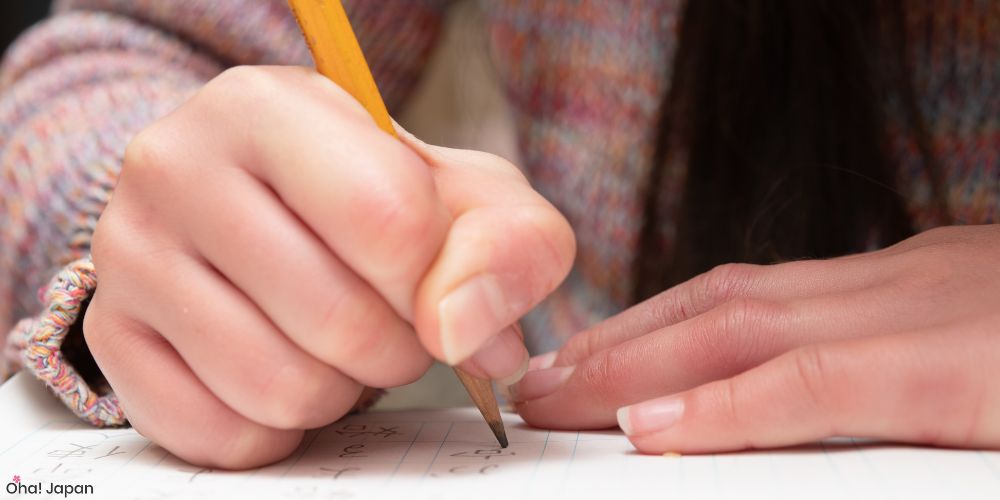
One thing teachers care a lot about is stroke order. They’ll correct you if you draw strokes out of order, not to be strict, but because it affects how clean and readable your writing is. Some kids get so used to the right order that even their messy handwriting still looks okay.
We use special grid notebooks (マスノート) that help us keep each character the right size. In some schools, we also do calligraphy (書道) classes using a brush and ink, which makes you even more aware of the shape and flow of each kanji.
5. Reading Is Easier Than Writing
By the time we reach upper grades, most students are way better at reading kanji than writing them. It’s easy to recognize a character when reading a manga or book, but if someone asks you to write it from memory, your mind just goes blank.
To improve, teachers give us these quizzes called 書き取りテスト, the teacher reads a word aloud and we have to write the correct kanji. It’s stressful, but it works.
There are many non-native english speakers who can recognize a character but cannot write.
6. The Kanji Kentei (漢字検定)
Outside of school, some students take the Kanji Kentei test (a.k.a. Kanken). It’s a big exam with levels from 10 (super basic) to level 1 (hard even for adults). A lot of kids go for Level 5 or 4 in upper elementary or junior high. Some go to cram school (塾) just to study for it.
Passing Kanken can be useful later as some high schools and companies see it as a plus.
7. Memory Tricks and Apps
Everyone has their own way of remembering tricky kanji. Some kids make up little stories. For example, the kanji for 林 (forest) is just two 木 (tree) characters. Simple, right?
Nowadays, kids also use apps. I remember some of my friends using their Nintendo DS to study kanji. There are apps that show stroke order animations or turn quiz drills into games. Some are surprisingly fun.
8. My Own Kanji Struggles
When I was a kid, I always messed up the kanji for 曜日 (like in 月曜日 – Monday). I could never remember all the strokes. My mom made flashcards and stuck them on the fridge. Every time I got a snack, I had to read one.
Even now, I sometimes forget how to write rare kanji. I usually just type it into my phone and let predictive text help me. Most adults do that, honestly.
9. Advice for Japanese Learners
If you’re learning Japanese, here’s my honest advice:
- Don’t worry about writing perfectly from the start and focus on reading first.
- Learn kanji in context, not in isolation. Reading kids’ books or manga helps.
- Try apps like Anki or WaniKani as spaced repetition works.
- Aim for understanding around 500 common kanji before worrying about obscure ones.
Also, be kind to yourself. We take over 10 years to learn all the basic kanji, and even then, we forget some. You don’t have to rush.


